Sunday, 12 April 2020

Peak passage.


I’ve been building up to a blog over the past week or so: I was going to detail the various arrivals and sightings over the past week or so of my daily legally sanctioned stroll from the house along the Devil’s Dyke. That might have to wait though, as this morning’s walk had more incident than the past week combined.


I’ve found by far the most effective form of social distancing, other than just staying in the house, is to get up and out before the joggers, strollers and dogists have even considered setting out – out here on the perimeter of the Ely10 circle I’m pretty much guaranteed not to see another human before 8am. And so it was that shortly after dawn this morning my trusty Australian sidekick and I were on our usual route, having already encountered chiffs, ‘caps, and a newly arrived willow warbler. Next was a flyover yellow wag and then the Dyke’s first whitethroat of the spring, jabbering incoherently from a patch of bramble – this provoked a weary sigh: I like this brief period in early April when I can enjoy the song of the early arrivals before the whitethroats’ incessant chuntering and churring becomes ubiquitous along the Dyke, but it looks like this blissful time is about to end for another year. We put this one quickly behind us and pressed on to enjoy the relative peace and quiet while it lasted.
The Australian, though a fast learner, isn’t fully familiar with the patterns of an English spring yet, so I was explaining that at this time one must meticulously check the blackbirds foraging at the edge of the sheep fields, just in case one isn’t quite as black as the rest. It was to my great delight that this tactic unexpectedly paid off in style, as I raised my bins to the latest dark Turdus just as it turned to reveal a crisp crescent of white. It proceeded to be most obliging, extracting various worms and leatherjackets from the short turf as it refueled for the next leg of its migration. Far better views than those of the lone rouzel to grace the Dyke last year, and best ever views of the species for the Australian.


Having got the day off to a flyer with this lad, we continued and, while I was scrutinising a corn bunting, newly returned to its favoured song perch, the Australian piped up with a query regarding a more distant bird along the same field boundary. A glance with the bins revealed something that looked a bit falcony, but not really that much bigger than the chubby bunting. The subsequent scope views duly revealed a female merlin, peering off across the fields and head-bobbing enthusiastically at something. With a final nod of confirmation, she was off, tearing low across the winter wheat with the species’ usual athleticism, bearing down on a far-off skylark. Eschewing the its larger cousins’ energy-saving, high altitude approach, it approached in typically gung-ho fashion, hugging the crop, accelerating for all it was worth and then engaging the lark in an ascending tail-chase. The lark could not match the merlin’s blistering speed, and was quickly hauled in, but it slammed on the handbrake and avoided the first attack at the last second by what looked like millimetres. The falcon immediately flared wings and tail and converted its considerable speed into height, heading vertical before stalling, folding its wings and dropping back over into a tight loop and a more peregrine-like stoop, but the skylark was up to the task, evading once, twice, then a third time – to a chorus of oohs, ahhs and shouted encouragement from the Australian (no friend of hapless passerines this Antipodean) – before the merlin decided, much to the Australian’s disappointment, that this was more trouble than it was worth and gave up the chase.


Pressing on, our next oddity was perhaps the most unusual (and underwhelming) of the lot, and unlike the earlier birds, a patch tick – a couple of house sparrows, a long way from the nearest house, that headed off high to the north-west.


Three wheatears, including a really big, bright Greenland type, were on their favoured fenceline over towards Swaffham Prior, and the last remaining fieldfare chattered manically away to itself in a hedge by the horse paddocks, having not got the memo about leaving with the rest of the gang last night. The local kestrel alighted on a nearby fence post, more obliging, if less dramatic, than the earlier falcon; its leisurely flop onto an unfortunate beetle not quite stirring the blood in the same way as the earlier high-stakes aerial pursuit.


Time to turn for home, lest the authorities catch up with us for overstaying our welcome; the sight of a couple of distant luminous Lycra-clad joggers approaching in the distance providing further impetus. There was still time for an unseasonal wandering jay to put in an appearance, dropping in from a very un-jay-like altitude to one of the hedgerows, before being encouraged to move on out across the open fields by a couple of local magpies. Finally, on the last stretch across the fields to home, a group of very accommodating golden plovers were sitting in the wheat, the first signs of heat haze beginning to blur their spangled plumage. 


To my Peak-trained eye these, like the ring ouzel and merlin earlier, always seem out of place away from the bilberry and heather, but fortunately for them, they are under no restrictions on their movements and will be back in the uplands before long. Sadly, the same can’t be said for the Australian and me, and this looks likely to be the first spring of my adult life that I won’t be able to spend some time with the ouzels and merlins, redstarts and wood warblers, pied flycatchers and all the other familiar birds of my youth in the Peak District, so we’re fortunate when we can catch these passing glimpses of such birds as they pass fleetingly through our lowland lockdown.

Thursday, 9 April 2020

Moon


And sometimes photos are weird for different reasons.


Wednesday, 8 April 2020

Distancing.


Having had to pop in to the pet supply shop over at Littleport, I thought I'd stop off at the Washes - because they are completely on my way, honest.
The breeze was virtually non existent, and the scene before me was only slightly tarnished by heat haze. At last the levels have dropped, and now the wash is revealing its spikes of Flag and bulrush, and vegetated islands of Bugle and other wetland plants have attracted passing waders and dabbling wildfowl. There are still Wigeon scattered across the shallow waters, and a sizeable flock of Godwits have yet to return to Iceland. While the resident breeders are settling onto territories - Redshank, Avocet and Limosa Godwits - this is just a stopover for the Ruff (probably....). A group of 24 loafed and pecked in the Spring warmth, sharing the lagoon with raucous Black-headed gulls and a few other waders.
Down at the causeway, a Stork shuffled across the drier compartments before disappearing along a ditch. 


Tuesday, 7 April 2020

Everything's Gone Green


I wouldn't usually take my scope on an early morning walk around the fields behind the house but I thought this would perhaps change my pace and focus.  I think it did as I stopped more frequently to watch and photograph birds I may normally acknowledge but not drink in. Singing Robin, House Sparrows nipping at blossom, Greenfinch displaying and Professor Yaffle a top a dead Ash.  Notable birds came in the form of Grey Partridge, a lingering Red Kite and a singing Cetti's Warbler in a reedy ditch, my first in the parish.


Monday, 6 April 2020

Isolation


Birding by bike has seemed like an option the past week or so as we become increasingly distanced from opportunities to get outdoors.  Thankfully the garden is not locked down and there's been plenty to wonder at.  Firstly, after many years of hoping, and quite a bit of tinkering around the pond to create newt hibernaculum, I was completely taken back to find a female Great Crested Newt at the bottom of the wheel barrow used to pick through the duck weed and rotting elodea removed from the clogged up pond.  I had to hold the lass to put her back in the pond but am fully aware of the need for a license to handle these beauties.


The following night a whatsapp prompt from Jono Leadley, who was hearing sea duck over inland Yorkshire, led me out to listen to the night in addition to having the noc mig recorder running.  Within minutes the peeping whistles of Common Scoter migrating overhead were heard, amazing.  Subsequently I heard more the following night alongside whistling Wigeon and a ticking Water Rail.  As ever it takes me forever to trawl through the nights sound recording and I'm several days behind - I'm hoping it'll have picked up the Scoter although these were not directly overhead, but quietly I'm hoping for some Brent Goose calls to lighten up the spectogram.

A brief report of a White Stork "in Ely" was followed by an early morning e-mail from Andrew Balmford saying a blue rung White Stork was in the meadow beneath the riverside Heronry.  I decided my daily exercise should take in the riverside and pots and I took a few pics of Herons and Cormorant before stumbling upon GB46, a very handsome White Stork from the Knepp Estate introduction that had relocated over the river in Springhead Meadow.  Nearby the White-fronted Goose that has lingered had relocated itself on to the Pits.  Alongside the Water Meadow a strident calling Pipit was most likely a Water but Rock Pipit couldn't be ruled out - unfortunately I wasn't able to locate the bird around the flood meadow.


Increasing time outdoors in the garden has led to more sky watching and alongside the resident and local Buzzards a couple of Marsh Harrier and wandering Red Kite provided welcome scarcity value.

We would have been travelling to Morocco today for a family road trip incorporating some brilliant birding spots.  Evidently we're very disappointed and hopefully this time next year we'll be able to travel to the deserts, mountains and coast of that wonderful country.

Sunday, 5 April 2020

Commoners not social distancing.

 I just looked out the window and spied the enchanting sight of a Robin sunning itself next to a Wren, which was doing the same.
Typically enough, by the time I'd got my camera, the birds had stopped sunning, but were still within the same square yard, and just as I was beginning to regret being able to capture the moment, A Dunnock skulked into view, and perched in the sunning spot for some stretching and a quick gape.


Elsewhere in the garden, a female Brambling has been visiting the feeder every day for over a week. It's lost some tertials and half its tail, so may stick around until they grow back.


Wednesday, 25 March 2020

March Movement in Self Isolation.

I was beginning to feel as though my casual assertion that March would bring some Redpoll and Siskin to the garden, was rather rash, but on Monday, I was alerted by a burst of "see-you" calls eminating from the rush of birds dissolving into the apple trees as I approached the feeders to top them off.
Back in the kitchen, a few minutes later I saw two female Siskins settle onto the niger feeder - head down in their typical fashion, one bird only visible by the tip of its tail poking from the rear of the metal tube. They were joined by a Goldfinch for a nice comparison - each species beautiful in its own idiosyncratic way. One a gaudy splash of contrasting colour, and the other a muted arrangement of complementary grey-green and black, highlighted with lemon.
They didn't stay long, and by the next day the main attraction was again the Reed Buntings - seven males huddled about the foot of the bird table, gleaning scraps that fell from the feeders as the Great Tits messily poked through the seed cache.


Saturday, 21 March 2020

Peregrine


It's always a treat when I get an e-mail from Simon Stirrup because they'll always be a cracking photograph attached.  We have frequent Peregrines around the E10 but it isn't easy to get such a fantastic image as the one above.  Over on the Washes at Welney this Aythya hybrid (I like Simon's Fool's Scaup label) was showing well.  


Wednesday, 18 March 2020

ReedHeads

Just some of the Reed Buntings caught and ringed in the garden over the last few years - all in march and April. It's this time of year when they pass through in good numbers. we ringed a couple of males on Saturday, and today there were four unringed  birds hopping about. There had been a ringed male for a few days last week, so that makes at least seven, and with numbers of females fairly similar, it goes to show just how many birds can pass through without our knowledge. 
The close up views gives a wonderful opportunity to see the surprising amount of variation in pattern - mostly down to feather wear.


Gender Phluid.

                                                                                             
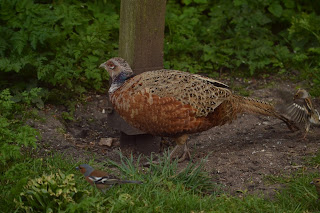
                                                                                                                                                             One of the Pheasants is Woke. Each year, up to a dozen pheasants wander round the garden, hoovering up the spillage from the feeders and generally milling about hiding from the local sportsmen. There's usually one or two males and a loose harem of females, and come the Spring the males start making noises and approach the females, plumage contorted in the stilted ceremony that shows off the iridescent Pre-Raphaelite patterns of maroon, red gold and deep pacific blue.  

But a few weeks ago, I noticed that one male was not quite the regal chevalier his garden mate had turned out to be. My first thought was that he was a young bird that hadn't fully moulted, but over a few days inspection - a different idea has emerged. 
It's long past the date where young birds have finished their moult into adult plumage, and yet this one bird still has not attained the greenish blue head with bold scarlet wattles and shining ear tufts. Its scapulars and mantle are still faded umber and black, and its orange underparts lack the glossy black diamonds and drops that give a male Pheasant its characteristic metallic feel. And it's small. Eventually I managed to see it side by side with one of the females - and apart from the longer tail, they were more or less the same size.


In close up, it was obvious the plumage  had both male and female features, with many feathers being an intermediate pattern. The bird has not appeared interested in the other females - no displaying or even stalking, and interestingly, the other - or should I say only male has attempted to court this bird a couple of times, slowly following it across the grass and adopting the hunchbacked, droop flanked, head bowing posture reminiscent of a Japanese kabuki actor sidling across the stage.


Side by side with the obvious male, this other bird is much smaller, and with all the other evidence taken into consideration, I guess it must be a female. I've never seen this genetic cross-dressing in Pheasants before - and I've seen a lot of pheasants over the years. But this is the 21st century after all - so deal with it.